The Article
RITA WIRELESS HEADPHONES FROM TANCHJIM
13th May 2026

Costing under £100 but still managing to look good, Paul Rigby books a date with Rita
The new, over the ear, 32 Ohm wireless Rita headphones, coloured in white only, from the Chinese company Tanchjim utilise 40mm dynamic drivers based on beryllium-coated, high-rigidity, dome-shaped composite diaphragms.

These headphones feature Active Noise Cancellation while Bluetooth 6.0 supports AAC and LDAC codecs with a 15 metre range and a reported 92 hour battery life. Which is a long time indeed. A wired option is available is that battery does fail while in use.

On-cup controls for the Rita headphones are minimal, being restricted to a power switch with auto-pairing, volume and play/pause. A USB-C socket is used for charging.

The headphones are packaged well, offering a rather luxurious presentation. The included manual is not particularly useful or informative, however. The online version is no better but users with even minimal experience with wireless headphones shouldn’t really need one in this case.
SOUND QUALITY
I began the sound tests by comparing the Ritas with my Sennhesier HD 4.50 BTNC Wireless headphones which cost around £170 when new but can now be yours for around the same price of the Ritas, if you shop around.
VS SENNHESIER HD 4.50 BTNC
I started in an audiophile frame of mind and connected both to my Astell&Kern Kann Alpha DAP and played The Doves’ Carousels from their Universal Want LP, a high-energy rock track but with plenty of fine details for the ear to pick out.
The Sennheisers relied on basic aptX in codec terms. I was looking forward to hearing the Rita’s LDAC performance on my Astell&Kern.

First thing that hit me from the Rita headphones was the bass response which was big, bold and over powering. This while running the Astell&Kern without any active EQs. The general output was not neutral, not balanced but definitely bass heavy.

Both mids and treble found it hard to be heard, both were rather swamped by that bass.
USING A SMARTPHONE
So I looked towards my Apple iPhone 15 instead because that held the company app that promised more control over the headphones’ sonic output. On that phone, after a fast Bluetooth connection and quick app firmware update, I loaded up the YouTube Music app on my iPhone and played It’s Over by Level 42 and Follow You Follow Me by Genesis.

In default mode, via the basic AAC codec, the headphones still favoured bass but that emphasis was much reduced.
Soundstage was relatively open, midrange was much more informative with emotive vocals while treble was further forward in the mix.
APP REPORT
Via the app, the Rita can play in three modes: default, transparency and ANC. The latter pushed the mids and treble forwards in the mix but that emphasis was a mite edgy. Transparency was the best balanced output of the three options with greater space around the soundstage. Sure, it was a little artificial but the effect remained relatively pleasant.
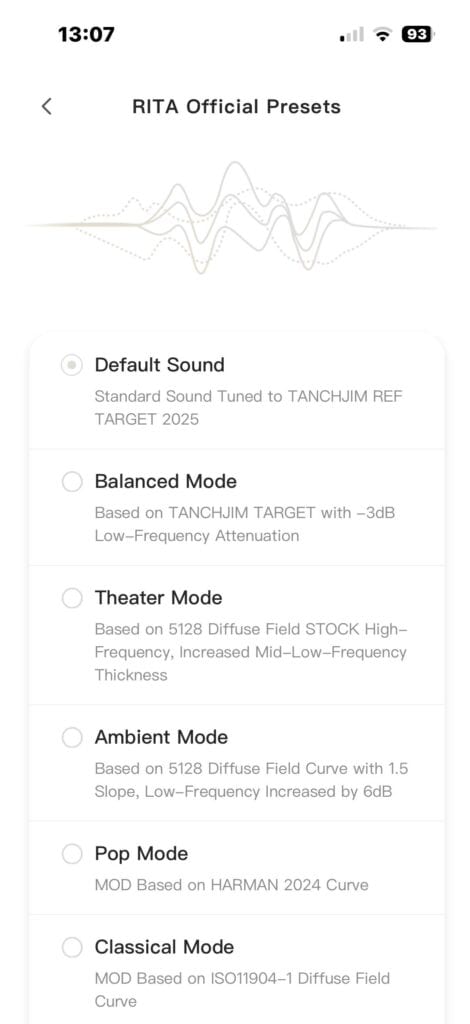
More EQs were offered via an Official Presets folder featuring EQs like: balanced, theater, ambient, pop, classical, OST, instrument and default. Each EQ provided bass or midrange emphasis or reduction. I stuck with the Default mode which appeared to offer the most balanced output of the lot.
LDAC or…?
I then switched on the LDAC tab on the app and I thought this option boosted all frequencies. Even so, I’m not sure why this option exists on my iPhone because that phone does not support LDAC.
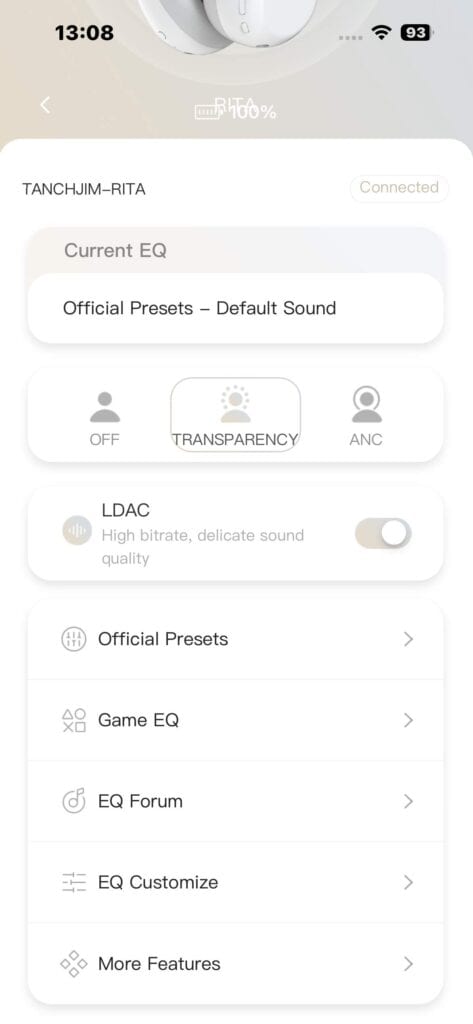
The basic chip level codec support is AAC only. I hope that users do not get the wrong idea about this app and believe that their phone is suddenly, magically supporting LDAC when it is clearly not. Thus, the LDAC option in the app on iPhone serves as yet another EQ option. And nothing more.
VS STAX SPIRIT S3
I then turned to the Stax Spirit S3 headphones at the markedly more expensive price of £319. I expected the Stax to sound better but I wondered by how much and in what way.
The answer was in every way. The S3s are suitable for HiFi use and will satisfy an audiophile’s demanding ears. Bass was integrated well into the mix, mids were relaxed, smooth and balanced while treble was delicate and nuanced. Moving from the Rita headphones to the Stax headphones was a night and day comparison in sonic terms.

The Tanchjim RITA headphones sound exactly what they are: fun, tweakable, lifestyle designs. The associated phone app is essential to tailor sound to the user’s ears.
CONCLUSION
Are these wireless headphones aimed at the audiophile user? No, absolutely not. They are for casual use only. And because they are easily modified, can be viewed as a decent, practical sonic tool. Ideal to accompany you on your morning constitutional, during a long-haul train journey or to act as a distraction while mowing the garden. That kind of thing.
Well packaged, lightweight, comfortable and well priced, the Tanchjim Rita headphones are ideal for general use.
TANCHJIM RITA WIRELESS HEADPHONES
Price: £100/$72/€87
GOOD: build, sound mods, comfort, lightweight, minimal styling
BAD: bass heavy, rolled off mids, treble insight
RATING: 7
Don’t forget to check out my Patreon Page at www.patreon.com/audiophileman, for exclusive postings and more!]
REFERENCE
Origin Live Sovereign turntable
Origin Live Enterprise 12″ arm
Icon PS3 phono amplifier
Aesthetix Calypso pre-amp
Blue Horizon Professional Rack System
Harmonic Resolution Systems Noise Reduction Components
Air Audio AC-2K Balanced Transformer
All vinyl was cleaned via a Degritter Mk.II
Connected Fidelity Six Star Power Block